Audit the Argument, Not the Prose: A Ten-Minute Reverse Outline for UK Coursework
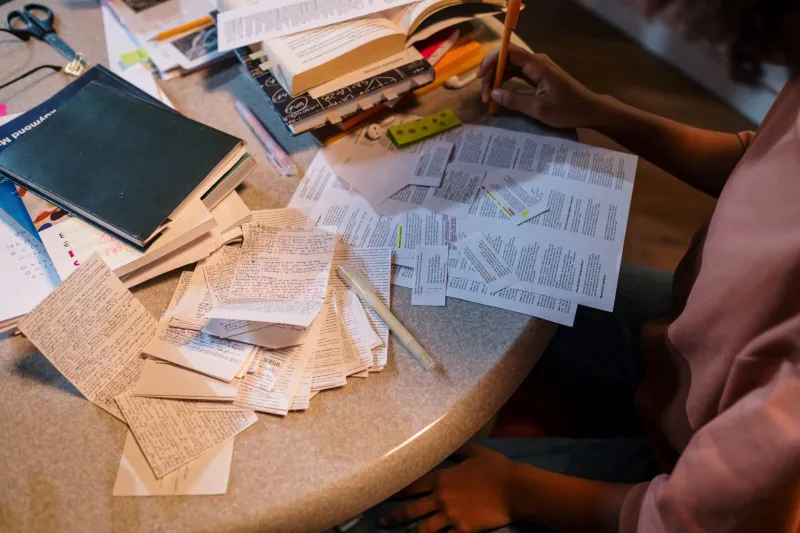
A coursework draft often feels more coherent to its author than it does on the page. You know what you meant to argue, so the paragraphs seem to connect. The reverse outline is a diagnostic check against that familiarity. It asks you to stop reading for polish and start reading for function: what is each paragraph actually doing, and does that work add up to the argument your introduction and conclusion promise?
The method is deliberately modest. It is not a rewriting technique, a substitute for proofreading, or a way to generate content. It is a ten-minute audit of structure and reasoning, best completed before you spend another hour adjusting sentences. For UK students working against tight submission dates in 2026, that distinction matters: the aim is to find the argument problem while there is still time to fix it.
What a Reverse Outline Is — and Is Not
A reverse outline works backwards from the finished draft. Instead of planning what each paragraph should do and then writing it, you take each existing paragraph and summarise its job in one sentence. The resulting list is the essay's skeleton as it currently stands, not as you imagined it.
It is not a summary of the topic. A sentence such as 'This paragraph is about social media' tells you the subject but not the function. A useful reverse-outline sentence names the move: 'This paragraph establishes the policy context', 'This paragraph challenges the first explanation', or 'This paragraph provides the main evidence for the claim that funding shapes outcomes'. The verb matters because it exposes whether the paragraph is doing argumentative work or merely occupying space.
Step One: Freeze the Draft and Label Each Paragraph's Job
Print the draft or open it in a view that discourages line editing. Number each paragraph in the main body, excluding the reference list and appendices. Read each paragraph once, then write a single sentence in the margin or in a separate document. Keep the sentence short and functional.
If you cannot summarise a paragraph in one sentence, treat that as a finding rather than a failure. It may contain two jobs that should be separated, or it may contain no clear job at all. If two consecutive paragraphs receive almost identical sentences, you have probably found repetition. If a paragraph's job is only to provide background that the reader does not need, it may be an orphan.
Step Two: Read the Skeleton Against the Introduction
The introduction is a set of promises. It usually identifies the question, explains why it matters, and indicates the route the argument will take. Your list of paragraph jobs should map onto those promises. Read the introduction again after the skeleton, not before it.
Ask three questions. First, does every paragraph job correspond to something the introduction led the reader to expect? Second, does the introduction promise a line of argument that no paragraph actually delivers? Third, does the order of paragraph jobs make sense as a sequence of reasoning, rather than as a sequence of topics?
This is where orphan paragraphs become visible. An orphan may be interesting, well written, and properly referenced, but if it does not serve the stated argument, it is likely to read as a detour. The remedy is not always deletion. Sometimes the introduction needs to acknowledge the point, or the paragraph needs to be linked more explicitly to the central claim. The audit tells you which conversation to have with your own draft.
Step Three: Check the Skeleton Against the Marking Rubric
UK coursework is usually assessed against explicit criteria. Read the rubric alongside your skeleton and note which paragraph jobs address which criteria. You are not trying to force every sentence to match a rubric phrase. You are checking whether the draft gives the marker evidence to award the marks available.
If the rubric rewards critical evaluation and your skeleton contains only description, the problem is structural. If it rewards analysis of primary evidence and your paragraph jobs mostly summarise secondary sources, the balance needs attention. If a criterion carries substantial weight but no paragraph clearly addresses it, decide whether that is a genuine gap or whether the criterion is not relevant to this assignment. The reverse outline makes that decision visible before the marking begins.
Step Four: Look for the Four Common Faults
Most structural problems in coursework drafts fall into a small number of categories. The reverse outline helps you spot them quickly.
- Orphan paragraphs. These do not connect to the introduction's promises or the conclusion's claims. They may be interesting, but they do not earn their place in this argument.
- Hidden counterarguments. A paragraph may concede a point without answering it, or a counterargument may be buried in a paragraph whose stated job is something else. If the skeleton shows a concession but no response, the argument is incomplete.
- Missing links. Two paragraph jobs may be individually sound but logically disconnected. The reader cannot see why one follows from the other. You may need a linking sentence, a reordering, or an explicit claim that turns the sequence into an argument.
- Conclusion drift. The conclusion may promise more than the draft delivers: a wider generalisation, a stronger causal claim, or a policy recommendation that the body never supports. The skeleton will show whether the final paragraph is earned.
Step Five: Test the Conclusion's Promises
Read the conclusion after the skeleton, not after the draft. Underline every claim it makes. Then check whether each claim has a corresponding paragraph job in the body. If the conclusion says the evidence 'demonstrates' something, the skeleton should show where that demonstration occurs. If it says the findings 'suggest' a broader implication, the body should contain the reasoning that makes the suggestion defensible.
A conclusion that overpromises is not necessarily dishonest; it is often the product of enthusiastic final drafting. The reverse outline simply makes the gap visible. You can then either strengthen the body or soften the conclusion. Both are legitimate fixes, but they produce different essays, so choose deliberately.
Keeping the Audit to Ten Minutes
The ten-minute limit is a discipline, not a rule. Its purpose is to stop the audit becoming another round of line editing. Use a timer. Write one sentence per paragraph. Do not rewrite sentences during the audit, even if you notice clumsy phrasing. Mark problems with symbols instead: O for orphan, C for counterargument, L for missing link, D for conclusion drift.
When the timer ends, choose the three most consequential findings. A draft with ten small stylistic issues may need less work than a draft with one missing counterargument and one overpromising conclusion. Prioritise the findings that affect the argument, then return to prose-level editing afterwards.
What to Do With the Findings
A reverse outline is most useful when it leads to a small number of deliberate changes. You might move a paragraph, write a linking sentence, add a response to a counterargument, delete an orphan, or revise the introduction so that it promises what the draft actually delivers. After making those changes, you can repeat the audit quickly to check that the skeleton now matches the promise.
This is also where academic integrity matters. The reverse outline is a tool for understanding and improving your own work. It should not be used to disguise the absence of your own reasoning or to retrofit a draft produced by someone else. The point is to make your argument visible to you, so that you can take responsibility for strengthening it.
A Final Pre-Submission Check
Before submission, ask one last question: if a marker read only your paragraph-job sentences, would they see the argument your introduction and conclusion describe? If the answer is yes, the draft is structurally ready for detailed proofreading. If the answer is no, you have found the most valuable revision task available. The reverse outline will not make the argument for you, but it will show you where the argument currently lives — and where it does not.